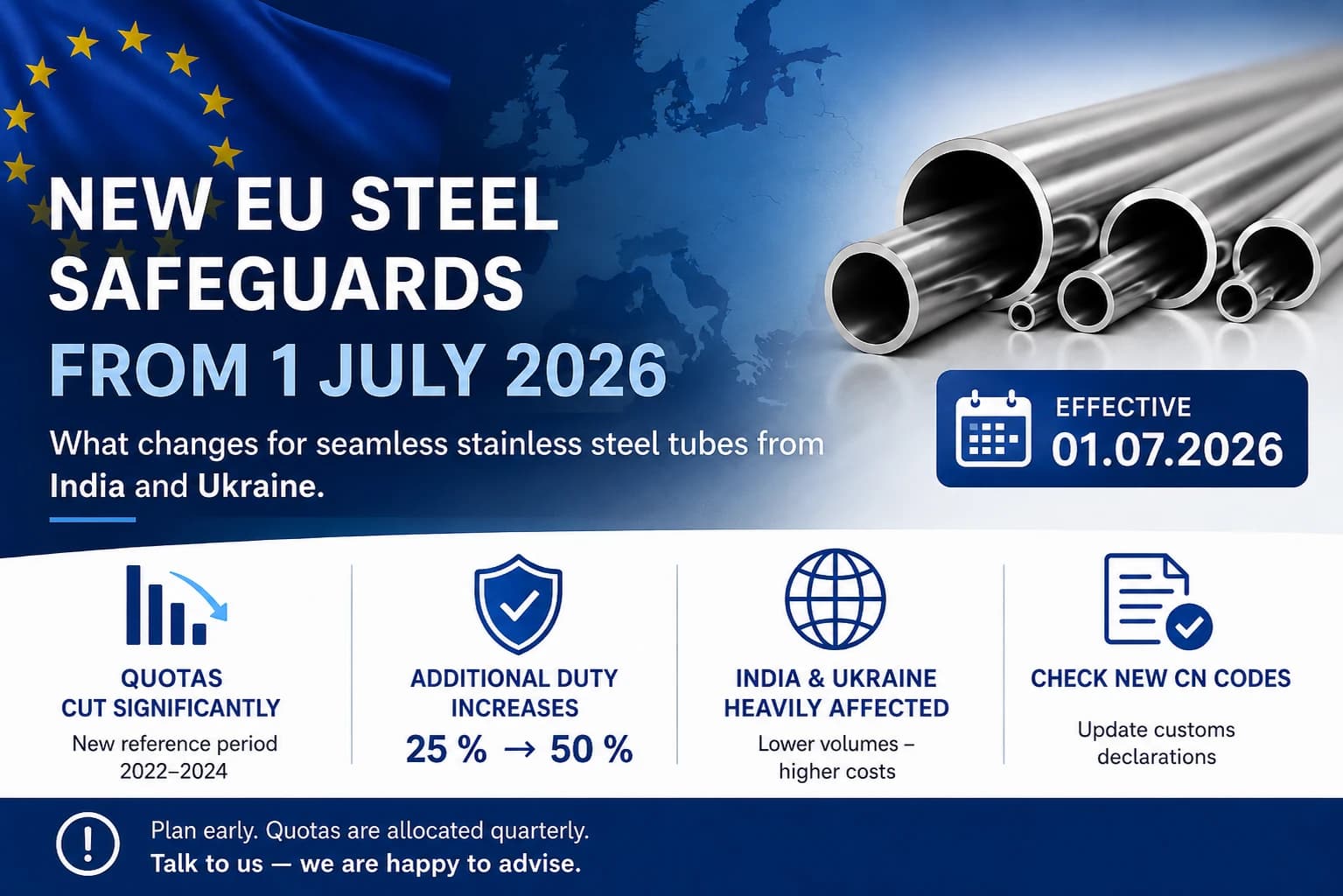
On 1 July 2026, the new Implementing Regulation (EU) 2026/1457 entered into force, replacing the steel safeguard Regulation (EU) 2019/159 that had applied since 2019. The changes affect all 26 steel product categories and bring significant updates for category 22 – seamless tubes and pipes of stainless steel, particularly for supplies from India and Ukraine.
We have summarised the points most relevant to your procurement below.
What has changed?
The EU has fundamentally reworked the safeguard mechanism:
- The out-of-quota additional duty rises from 25% to 50%. Imports above the quota limits become considerably more expensive.
- The new reference period for calculating quotas is 2022–2024 (previously 2015–2017). Since exports from India and Ukraine to the EU were lower in this period, the quotas have decreased accordingly.
- A four-tier access model now applies – with country-specific quotas, FTA fallback pools and residual quotas – replacing the previous two-tier system.
- Quotas are allocated quarterly on a first come, first served basis.
Category 22 – quotas compared
| Country | Annual quota before (2019/20) | Annual quota new (from 01.07.26) | Change | Quarterly | Order no. |
|---|---|---|---|---|---|
| India | 21,390 t | 15,329 t | – 28% | 3,832 t | 09.9928 |
| Ukraine | 13,439 t | 6,524 t | – 51% | 1,631 t | 09.9929 |
| Korea | 4,242 t | 2,392 t | – 44% | 598 t | 09.9931 |
| China | 3,344 t | 1,073 t | – 68% | 268 t | 09.9930 |
| Japan | 4,091 t | 714 t* | – 83% | 179 t | 09.9750 |
| FTA quota pool | – | 2,051 t (new) | new | 513 t | 09.9523 |
| Other countries | 7,300 t | 3,097 t | – 58% | 774 t | 09.9623 |
* Japan now only has access to a residual quota, no longer a country-specific quota.
Focus: India
India remains by far the largest single supplier of seamless stainless steel tubes to the EU. Its annual quota nevertheless drops from 21,390 t to 15,329 t (–28%).
As India has a free trade agreement (FTA) with the EU, its quota is split into two access tiers:
- MFN portion: 7,886 t/year – equally accessible to all trading partners
- FTA portion: 7,442 t/year – exclusively for suppliers with FTA preferential proof of origin
Both portions run under one order number (09.9928) and can be used in parallel. Once the country-specific quota is exhausted, there is additional access to the FTA fallback pool (09.9523, 2,051 t/year, shared with other FTA countries).
Practical impact: The quarterly volumes available from India are tighter. In periods of high demand, the country-specific quota may be exhausted early in the quarter. Procurement planning should be initiated early in each quarter.
Focus: Ukraine
Ukraine is also an FTA partner of the EU. Its annual quota in category 22 is nearly halved: from 13,439 t to 6,524 t (–51%).
- MFN portion: 3,357 t/year
- FTA portion: 3,168 t/year
- Order number: 09.9929 | Quarterly: 1,631 t
Ukraine additionally has access to the FTA fallback pool (09.9523), but only once its own country-specific quota is exhausted.
Practical impact: At around 1,631 t per quarter, the Ukrainian quota is very limited. Volumes that were previously sourced routinely from Ukraine may in future only be available to a limited extent or at significantly higher cost (50% out-of-quota duty).
Updated CN codes
The new regulation also revises the Combined Nomenclature codes for category 22. Please review your customs declarations:
| Old (2019/159) | New (2026/1457) |
|---|---|
| 7304 49 10 | discontinued |
| 7304 49 93 | → 7304 49 83 |
| 7304 49 95 | → 7304 49 85 |
| 7304 49 99 | → 7304 49 89 |
Unchanged: 7304 11 00 · 7304 22 00 · 7304 24 00 · 7304 41 00
What do we recommend?
- Plan early: Quotas are released quarterly and exhausted quickly. We recommend reporting your requirements well before the start of each quarter.
- Review sourcing diversification: Given the sharply reduced Ukrainian quota, it is worth looking at alternative sources of supply.
- Update CN codes: Make sure your customs declarations and ERP master data reflect the new category 22 codes.
- Quota monitoring: We continuously monitor the utilisation of the relevant quotas and will inform you proactively as soon as a bottleneck becomes foreseeable.
Get in touch – we will be happy to advise you individually on the best procurement strategy under the new framework.
Legal notice: This information is based on Implementing Regulation (EU) 2026/1457 (OJ L, 30 June 2026) and Implementing Regulation (EU) 2019/159. All information without guarantee. As of: 1 July 2026.