
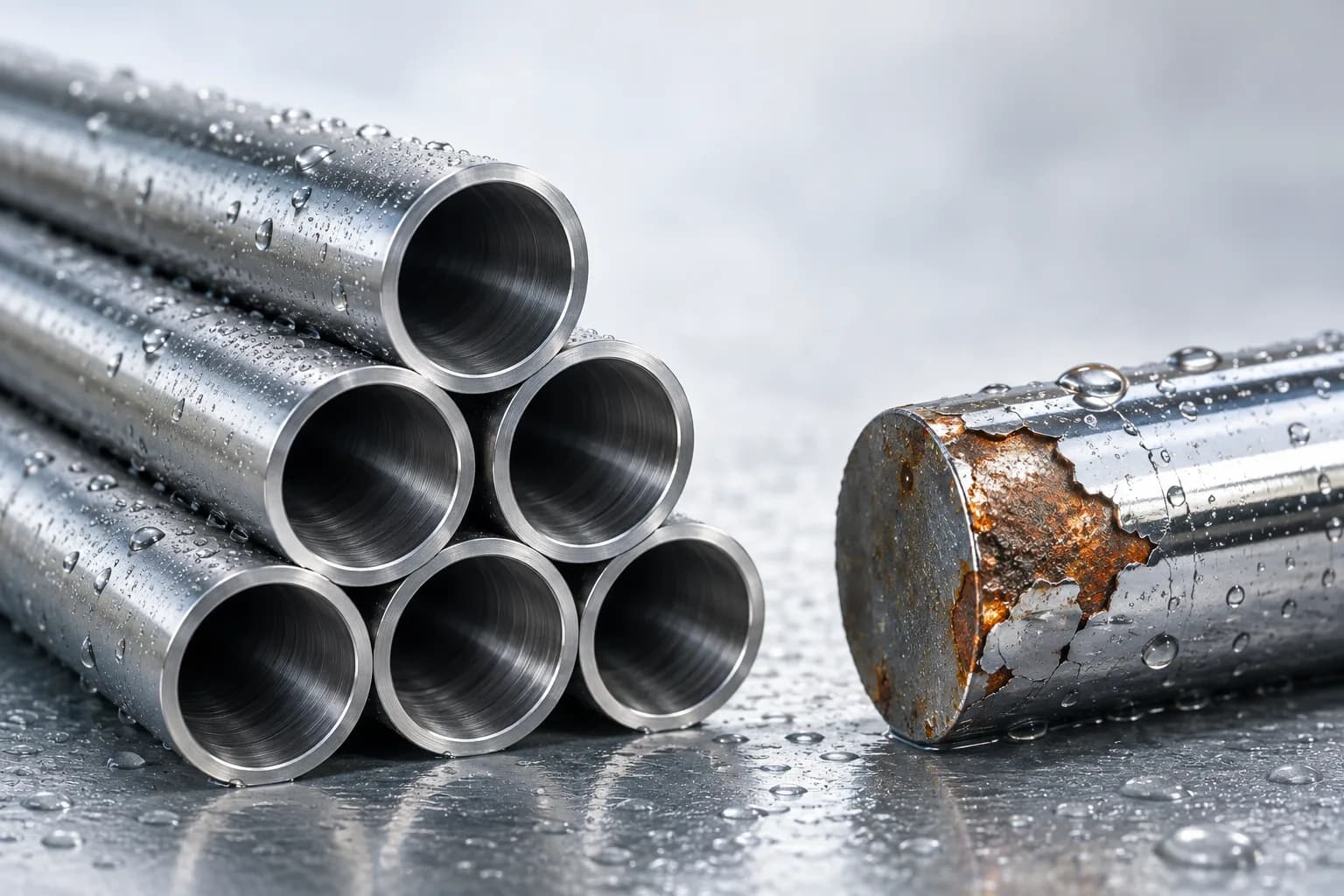
Stainless steel is often called a “green” material, usually with a nod to its recyclability. That is true, but it sells the material short. The real strength of stainless steel lies in the combination of circularity, long service life and corrosion protection that cannot be worn away. This is exactly where it differs fundamentally from chrome-plated carbon steel, where a thin layer of chromium has to protect a core that rusts.
This article summarises the current facts: recycling rates, carbon footprint, the mechanism behind corrosion resistance, the regulation of hexavalent chromium and life cycle costs. It is written for buyers, design engineers and planners who need to justify material decisions.
Key facts at a glance
- Recycling: At least 95% of stainless steel is recycled at the end of its life. Chromium, nickel and molybdenum are fully recovered; there is no downcycling.
- Scrap share: European stainless steel mills operate with scrap shares well above 85%. Outokumpu reports a recycled content of 97% for 2025 and an average product carbon footprint of 1.6 kg CO₂e per kg of stainless steel.
- Corrosion protection: Stainless steel protects itself with a self-healing chromium oxide passive layer just 1 to 3 nanometres thick, formed from the material itself. Chrome-plated carbon steel is protected only as long as the coating is intact.
- Hexavalent chromium: Electroplated chrome is based on chromium trioxide, a carcinogenic Cr(VI) substance. The EU is working on a restriction under REACH Annex XVII; supply chains are under pressure.
- Cost: Stainless steel costs more to buy but usually less over its service life in corrosive environments: no re-coating, longer life, high scrap value.
How well is stainless steel actually recycled?
Stainless steel is one of the most completely recycled materials in existence. According to the industry association worldstainless, at least 95% of stainless steel is recycled at the end of its life. The reason is economic: stainless scrap contains chromium, nickel and molybdenum and is therefore worth several times as much as carbon steel scrap. It gets collected because it is worth money.
Crucially, stainless steel loses no quality in recycling. Scrap is melted in an electric arc furnace, the alloying elements are retained and go straight into the new steel. A decommissioned heat exchanger tube can become a heat exchanger tube again. Coated materials behave differently: the chromium layer on a plated component is worthless in the melt and contributes no alloying effect.
So why is the global average recycled content of new stainless steel only around 48%? Not because too little is collected, but because stainless products typically stay in service for 20 to 50 years or more and the world market is growing faster than end-of-life scrap becomes available. In Europe, with its mature installed base, the scrap share is above 85%. That is the base our tubes come from.
What is the carbon footprint of stainless steel?
Stainless steel production is energy-intensive, but the spread between production routes is enormous. The worldstainless CO₂ emissions report gives an average of 0.39 t CO₂ (scope 1) and 0.49 t CO₂ (scope 2) per tonne of stainless steel for scrap-based electric arc furnace production. The biggest lever sits in scope 3, the raw materials: every tonne of scrap replaces nickel, chromium and iron that would otherwise have to be mined, processed and reduced.
European mills with a high scrap share and low-carbon electricity therefore sit far below the global average. Outokumpu states its average product carbon footprint for 2025 as 1.6 kg CO₂e per kg of stainless steel, around 75% below the industry average. Stainless steel based on nickel pig iron made with coal power, as produced in parts of Asia, can cause several times that.
For buyers this means: “stainless steel” is not a carbon figure; the origin is. Anyone who has to report scope 3 emissions should ask for environmental product declarations (EPDs) or mill-specific product carbon footprints. We provide this data for our stock on request.
Why is stainless steel better than chrome-plated carbon steel in corrosive environments?
The difference is not the chromium. It is where the chromium sits.
Stainless steel contains at least 10.5% chromium throughout its entire volume. In air or water, a chromium oxide passive layer 1 to 3 nanometres thick forms spontaneously on the surface. If it is damaged by a scratch, machining or an impact, it re-forms within seconds, because the chromium beneath reacts immediately. Corrosion resistance is a material property, not a surface treatment.
Chrome-plated carbon steel works the other way round. The core is ordinary steel that rusts as soon as it sees moisture. On top sits, for decorative chrome, a chromium layer a few tenths of a micrometre thick over a nickel undercoat, or for hard chrome, on piston rods for example, typically 20 to 50 µm. This layer has three inherent weaknesses:
- It is cracked. Electroplated hard chromium is hard and brittle; as it is deposited it forms a network of micro-cracks that can reach the base metal. Moisture finds a way in.
- It offers no sacrificial protection. Chromium and nickel are more noble than steel. Unlike zinc, they do not protect the steel at a defect but attack it: a small exposed steel area (anode) faces a large chromium area (cathode), which accelerates local corrosion. The result is pitting and under-film rust that lifts the coating.
- It cannot be repaired in service. Once the layer is damaged, the only fix is removal and re-plating. On stainless steel a scratch is cosmetic, not functional.
| Criterion | Stainless steel | Chrome-plated carbon steel |
|---|---|---|
| Corrosion protection | Passive layer from the material itself, self-healing | Coating of finite thickness, not self-healing |
| Behaviour when damaged | Repassivates within seconds | Accelerated corrosion at the defect, under-film rust |
| Cut edges, drilled holes, welds | Resistant | Unprotected unless post-treated |
| Recycling | ≥ 95%, alloy content recovered | Recyclable as carbon steel, chromium layer has no value |
| Health and environment in manufacturing | No electroplating required | Cr(VI) electrolytes, possibly PFAS-based mist suppressants |
| Maintenance | Cleaning | Inspection, re-coating, replacement |
| Purchase price | Higher | Lower |
| Life cycle cost in corrosive environments | Usually lower | Usually higher |
There are applications where hard chrome still has its place: dry indoor environments, purely wear-driven requirements, very hard sliding surfaces against seals. But wherever moisture, salt, chemicals or cleaning agents are involved, the protection offered by chrome-plated carbon steel rests on a layer thinner than a human hair.
Hexavalent chromium: the regulatory pressure on chrome plating
Electroplated chrome is deposited almost exclusively from chromium trioxide electrolytes. Chromium trioxide is a hexavalent chromium (Cr(VI)) substance classified as carcinogenic. In the EU it has been subject to authorisation under REACH Annex XIV since the sunset date of 21 September 2017; every plating shop has since needed its own authorisation or has had to operate under its supplier's.
The pressure keeps growing. In April 2025 the European Chemicals Agency (ECHA) published a proposal to move chromium trioxide and other Cr(VI) compounds into a restriction under Annex XVII. The Committee for Socio-economic Analysis (SEAC) adopted its draft opinion in June 2026, and the public consultation closed in August 2026. The Commission's final decision is still pending; transition periods and exemptions are to be expected, but the direction is clear: chrome plating in Europe is becoming more expensive, more complicated and harder to source.
There is a second issue. To suppress Cr(VI) mist, plating baths use wetting agents that were historically based on PFOS and today often on other per- and polyfluoroalkyl substances (PFAS). This group of substances is also facing an EU restriction. Anyone specifying chrome-plated components today is buying a double regulatory risk into their supply chain. Stainless steel needs no electroplating.
Life cycle cost: more to buy, less to own
The decision for chrome-plated carbon steel is often made on unit price. The true cost only shows over the service life. Life cycle costing (LCC) accounts for purchase, installation, maintenance, downtime, replacement and residual value. In corrosive environments the balance regularly tips in favour of stainless steel:
- No re-coating. Plated and galvanised components have to be inspected and eventually renewed; a galvanised component outdoors is typically replaced after around 20 years.
- Fewer unplanned stoppages. A corroded piston rod or tube section rarely costs only the spare part. It costs the plant that is standing still.
- Residual value instead of disposal cost. In Europe, stainless scrap fetches several times the price of carbon steel scrap depending on grade and nickel price. At the end of its life the component pays part of its price back.
- A documented example. For the Progreso pier in Mexico, built in 1941 with concrete reinforced by 1.4301 stainless steel, the Nickel Institute calculated that an equivalent structure with carbon steel reinforcement would have cost around 44% more in total by 2020. The neighbouring carbon steel pier no longer exists.
Where does switching from chrome-plated carbon steel to stainless pay off?
In our experience these are the applications where customers most often move from chrome-plated carbon steel to stainless steel:
- Hydraulics and instrumentation outdoors, offshore and in agriculture. Line tubing and cylinder components exposed to rain, road salt, slurry or salt spray. 1.4404 (316L) and 1.4571 (316Ti) prove themselves here.
- Food, pharma and cleaning processes. Wherever chlorides, acids or cleaning media are used and no coating particles may enter the product.
- Architecture and railings. Handrails, posts and visible tubes that should look the way they did on day one. Indoors 1.4301 (304) is usually enough; outdoors and near the coast, 1.4404.
- Water and wastewater engineering. Pipework in constant contact with the medium, where a coating defect means total failure.
- Highly loaded structures in contact with chlorides. Duplex grades such as 1.4362 combine high strength with good resistance and allow thinner walls, meaning less material and less weight.
The right grade depends on medium, temperature and chloride content. Our materials overview lists composition, mechanical properties and typical applications for all common stainless steel grades.
What we recommend
- Calculate in life cycle costs, not unit prices. Include maintenance, replacement, downtime and residual value in the calculation.
- Choose the grade for the environment. 1.4301 for indoor and mild conditions, 1.4404 or 1.4571 where chlorides are present, duplex where high strength is required.
- Ask for carbon data. An EPD or mill-specific product carbon footprint instead of an industry average. European stainless steel with a high scrap share performs considerably better.
- Check your supply chain for Cr(VI). Anyone using chrome-plated components should know under which REACH authorisation they were plated and how long it remains valid.
Would you like to convert an existing application from chrome-plated steel to stainless steel, or do you need material data for your sustainability reporting? Get in touch. We supply seamless stainless steel tubes, hydraulic line tubing and instrumentation tubes from stock and advise on grade selection.
Sources: worldstainless: Recycling · worldstainless: Stainless steel CO₂ emissions report · Team Stainless: The Global Life Cycle of Stainless Steels · Outokumpu: Product carbon footprint · ECHA: Restriction process for chromium(VI) substances · ECHA: Highlights from March RAC and SEAC meetings 2026 · ASSDA: Stainless steel, sustainability and life cycle costing · Nickel Institute: Plating. All figures to the best of our knowledge as of September 2026; they do not replace application-specific material testing.